Introduction
The Basenji, known as the African Barkless Dog, is considered by its devotees as unique to the species. One of the oldest of breeds, Basenji-type dogs are depicted on the tombs of the Pharaohs and date back to as early as 3600 B.C. Small and short haired, with a foxy face, worried-looking wrinkled brow, upright ears and tail curled like a doughnut, the Basenji's most unusual characteristic is that it does not bark. He is, however, not mute and, although usually quiet, has a repertoire of sounds that range from a pleased throaty crow to a keening wail when he is lonely or unhappy.
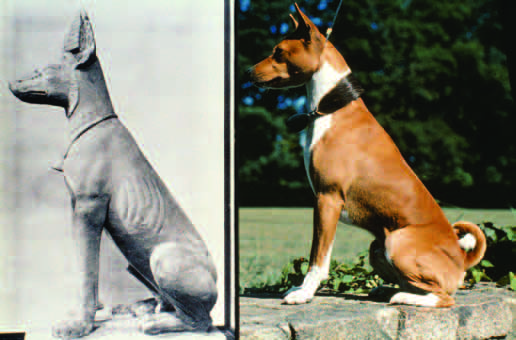
The first sightings of Basenjis by Europeans came in the 1870s among the local peoples of the Ubangi-Uele basin in central Africa. They were first and foremost a hunting dog. The natives valued those dogs that excelled in the hunt and placed considerable emphasis on the dog's intelligence, courage and adaptability. The dogs were products of natural selection with only the most fit and cunning surviving to produce the next generation.
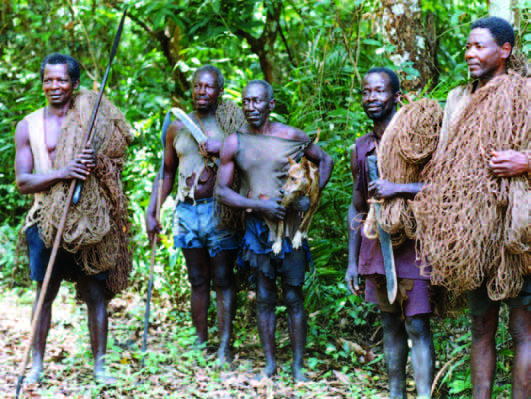
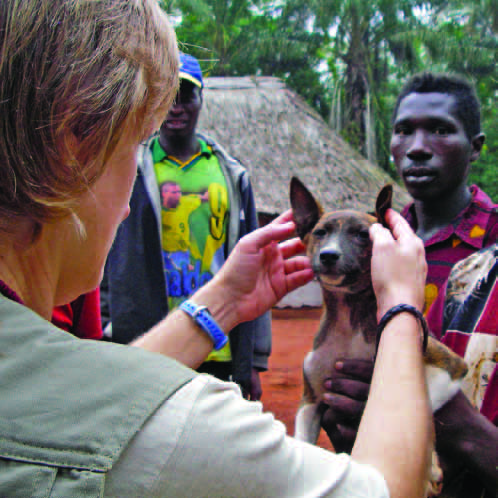
The Basenji is still found in some areas of Africa where they continue to live with natives in remote forests and are extensively used to hunt. Well-balanced, graceful and active, the 16 to 17-inch height allows a functional yet sustainable size in a harsh, subsistence-level environment. Basenjis hunt using both sight and scent and are used to assist beaters in flushing game that is driven into nets strung up against the trees.
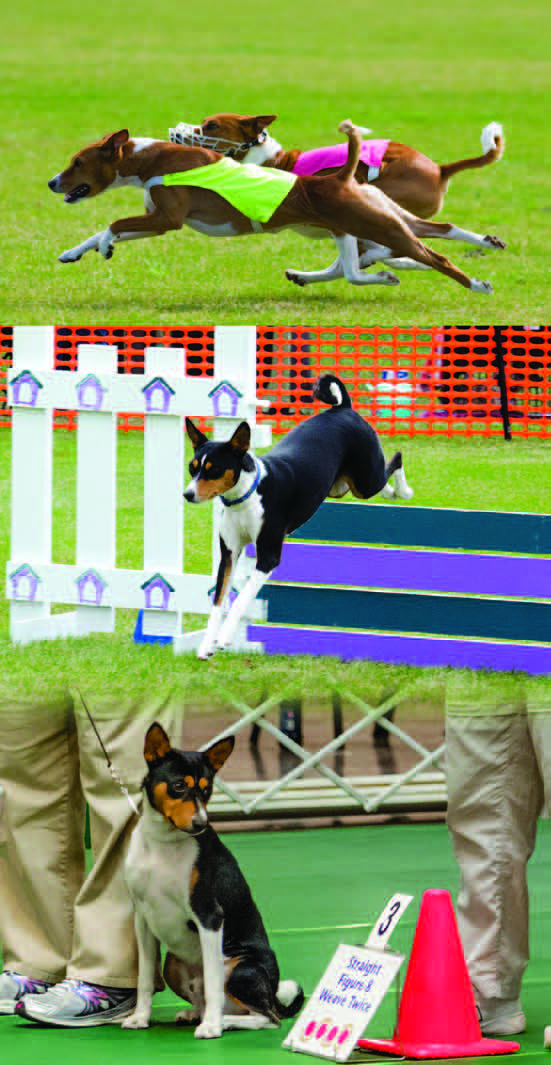
Today, Basenjis continue to demonstrate their hunting skills in organized lure coursing trials. Many have won the honor of Best in Field against other sighthound breeds. Their scenting ability has been proven by those dogs that have earned degrees in Tracking. Individual Basenjis have received high honors in many other sanctioned venues making the Basenji an ancient dog with wide-ranging abilities. Training a Basenji is challenging, yet with patience and humor, many owners are rewarded by their dogs doing what is wanted.
General Appearance
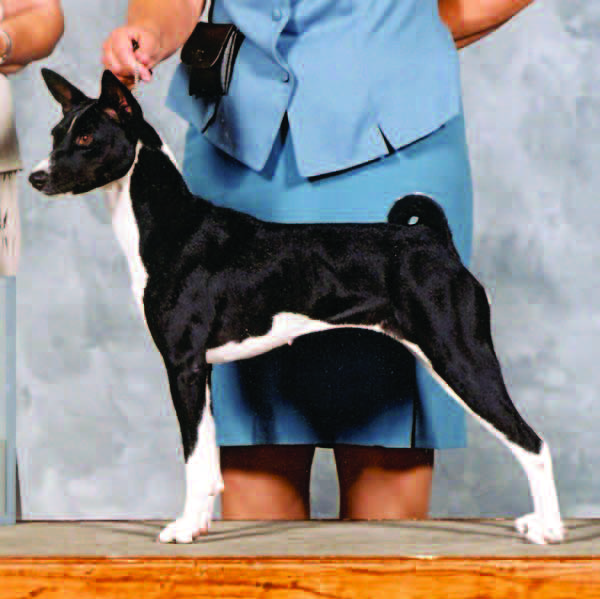
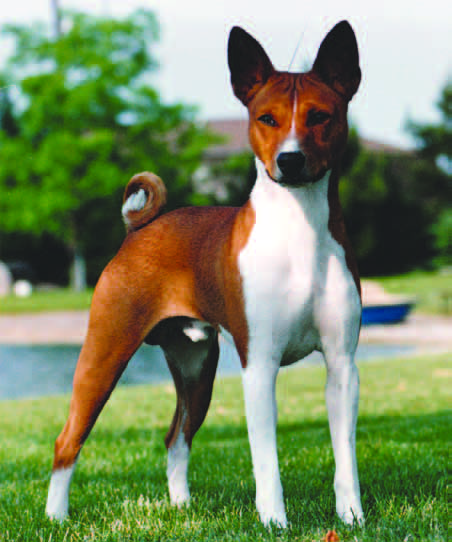
The Basenji is a small, short haired hunting dog from Africa. It is short backed and lightly built, appearing high on the leg compared to its length. The wrinkled head is proudly carried on a well arched neck and the tail is set high and curled. Elegant and graceful, the whole demeanor is one of poise and inquiring alertness. The balanced structure and the smooth musculature enables it to move with ease and agility. The Basenji hunts by both sight and scent.
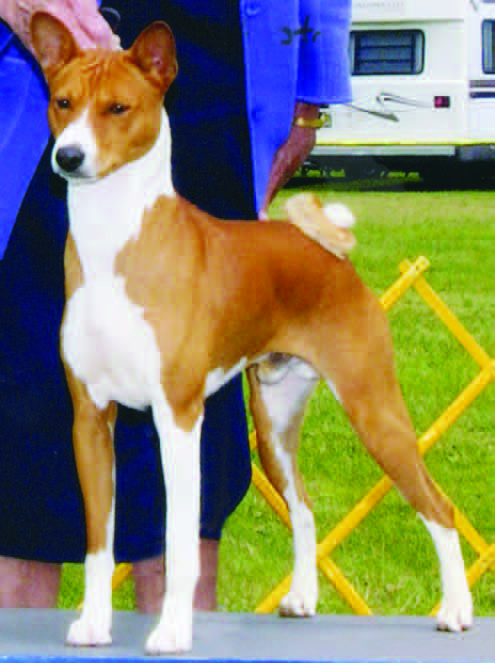
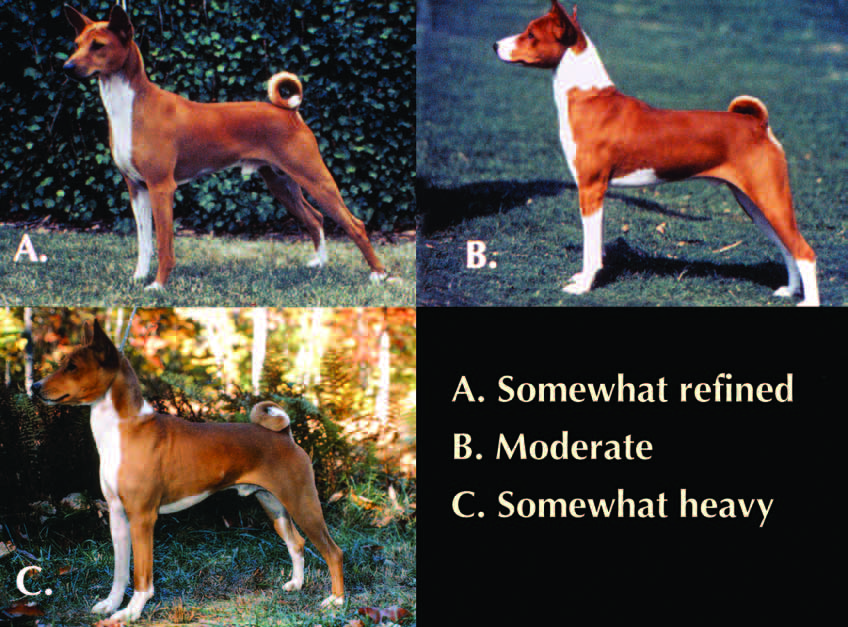
The Basenji combines strength and elegance with graceful lines and aristocratic bearing. Gazelle-like grace is the hallmark of the Basenji. The dog is lightly built, but not weedy. The deep brisket carries back to a definite waist. Coarseness of body and heavy bone is to be avoided, as is excessive size. The impression of a dog high on the leg compared to its length cannot be overemphasized.
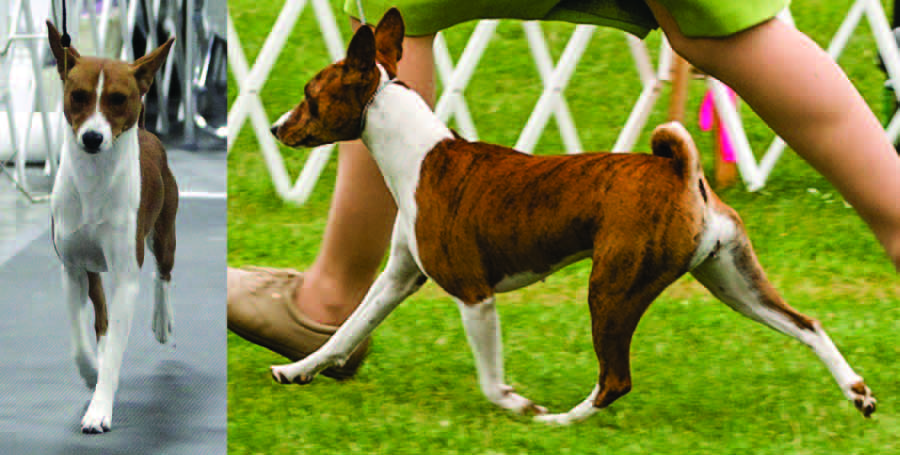
Basenjis are considered sighthounds and several have won Best in Field in open competition with all sighthound breeds. Basenjis are also scenthounds, and several have earned tracking degrees, while others have shown considerable aptitude in gundog field trials. They are a general-purpose breed rather than a highly specialized, selectively-bred classical hunting breed.
Characteristics: The Basenji should not bark but is not mute. The wrinkled forehead, tightly curled tail and swift, effortless gait (resembling a racehorse trotting full out) are typical of the breed.
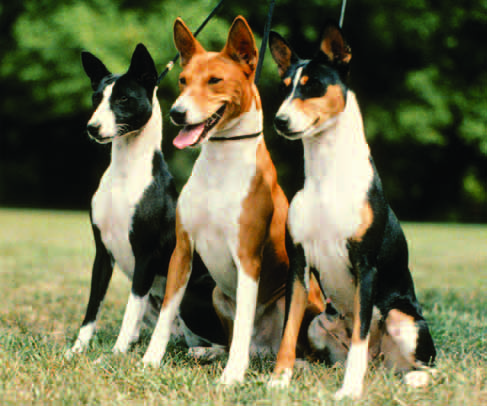
The wrinkled head and tightly curled tail set the Basenji breed apart. The prick ears contribute to the alert appearance. In good Basenji gait, the stride should be long, reaching, and ground covering. It appears effortless and can be maintained for great distances. Effortless grace is a better indication of good movement than high speed in the trotting Basenji.
Faults: Any departure from the following points must be considered a fault, and the seriousness with which the fault is regarded is to be in exact proportion to its degree.
Size, Proportion, Substance
Ideal height for dogs is 17 inches and bitches 16 inches. Dogs 17 inches and bitches 16 inches from front of chest to point of buttocks. Approximate weight for dogs, 24 pounds and bitches, 22 pounds. Lightly built within this height to weight ratio.
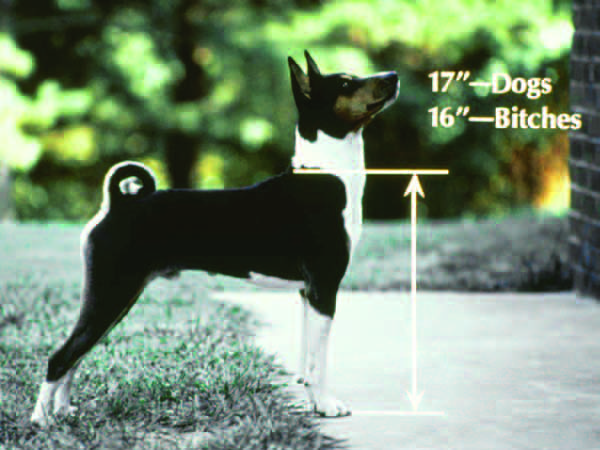
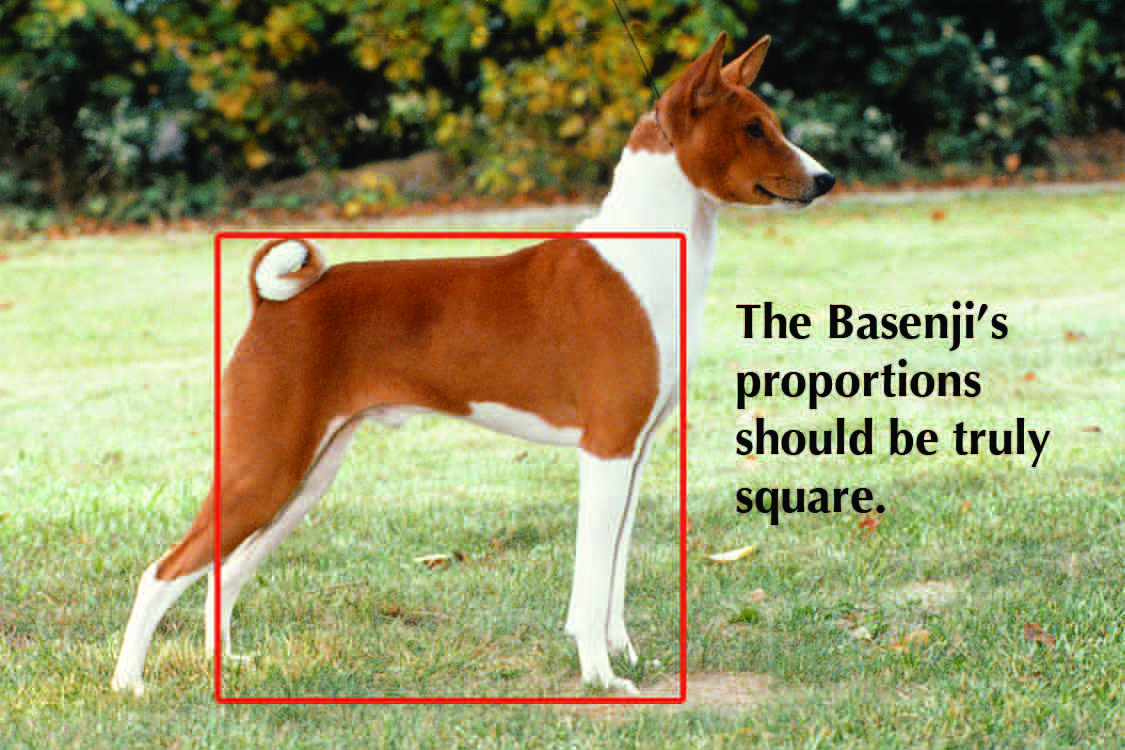
Over the years there has been a tendency for Basenjis to become even larger. Today, dogs two inches over the standard are frequently seen in the ring. The standard has no disqualifications for size, but the optimum heights are those stated.
Head
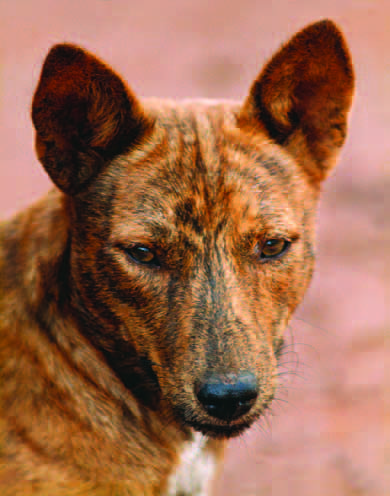
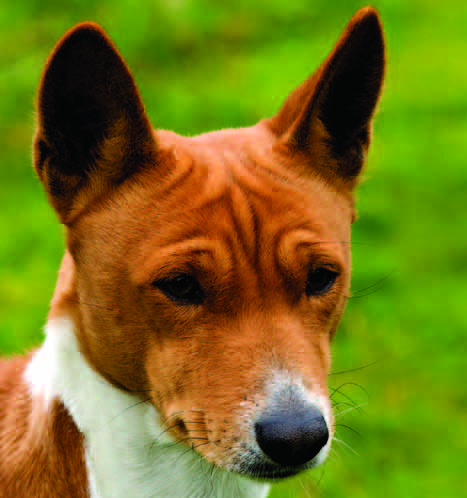
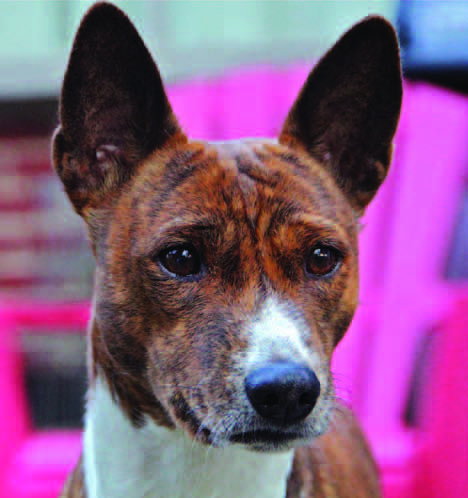
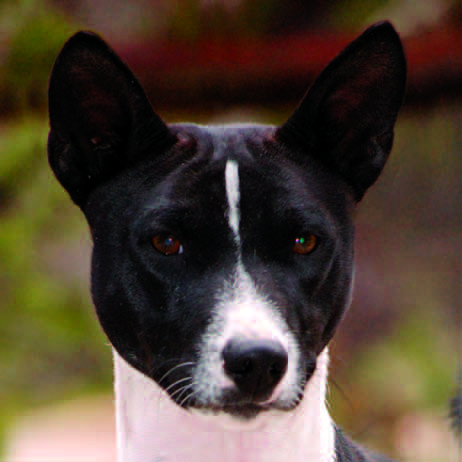
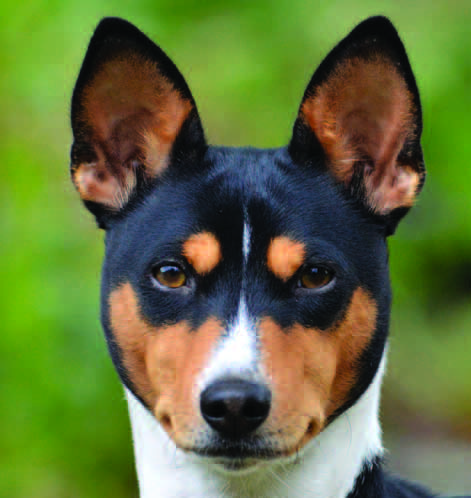
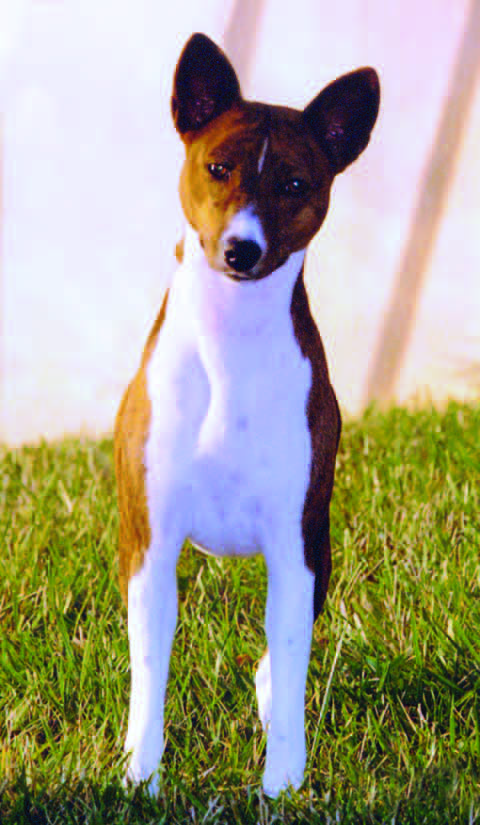
The head is proudly carried. Eyes: Dark hazel to dark brown, almond shaped, obliquely set and farseeing. Rims dark. Ears: Small, erect and slightly hooded, of fine texture and set well forward on top of head. The skull is flat, well chiseled and of medium width, tapering toward the eyes. The foreface tapers from eye to muzzle with a perceptible stop. Muzzle shorter than skull, neither coarse nor snipy, but with rounded cushions. Wrinkles appear upon the forehead when ears are erect, and are fine and profuse. Side wrinkles are desirable, but should never be exaggerated into dewlap. Wrinkles are most noticeable in puppies, and because of lack of shadowing, less noticeable in blacks, tricolors and brindles. Nose: Black greatly desired. Teeth: Evenly aligned with a scissors bite.
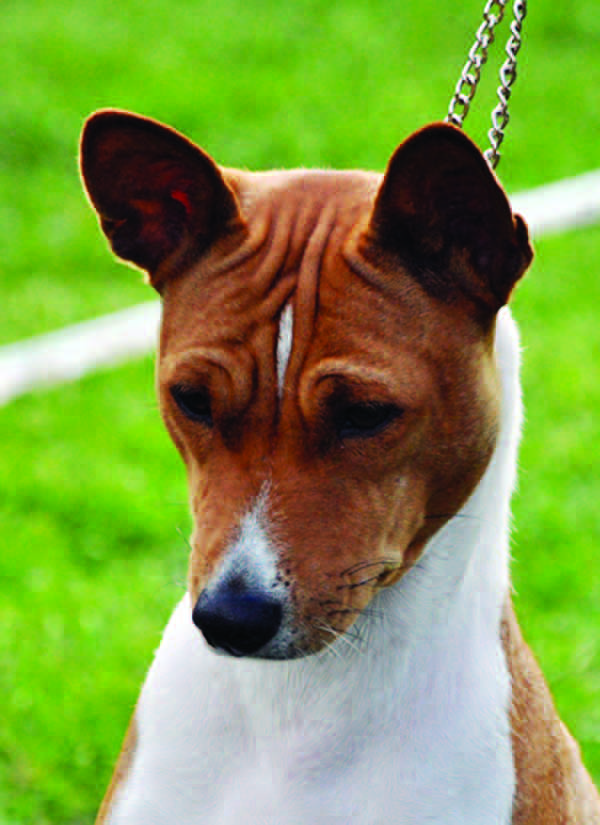
The small, forward-inclined prick ears, the fine, profuse wrinkles, and the obliquely set eyes with the correct head shape combine to create an attractive and distinctive head. A female should look feminine and a male should look masculine.
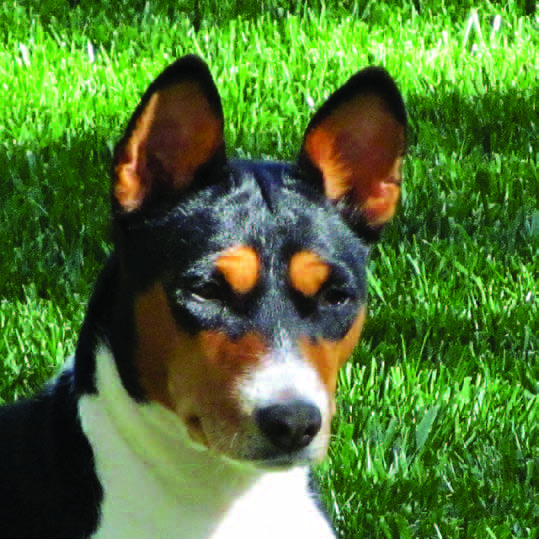
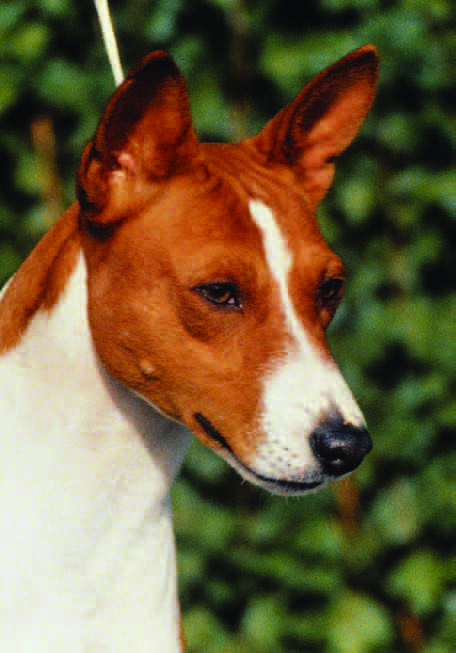
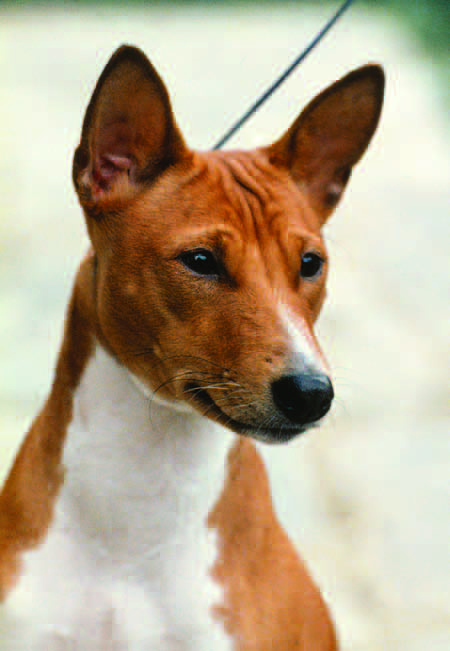
The smooth transition of the skull into the muzzle can be best illustrated from above. The head is seen as all one piece: the sides of the skull narrowing slightly toward the eyes, the foreface tapering toward the shorter muzzle, the muzzle neither coarse nor snipy.
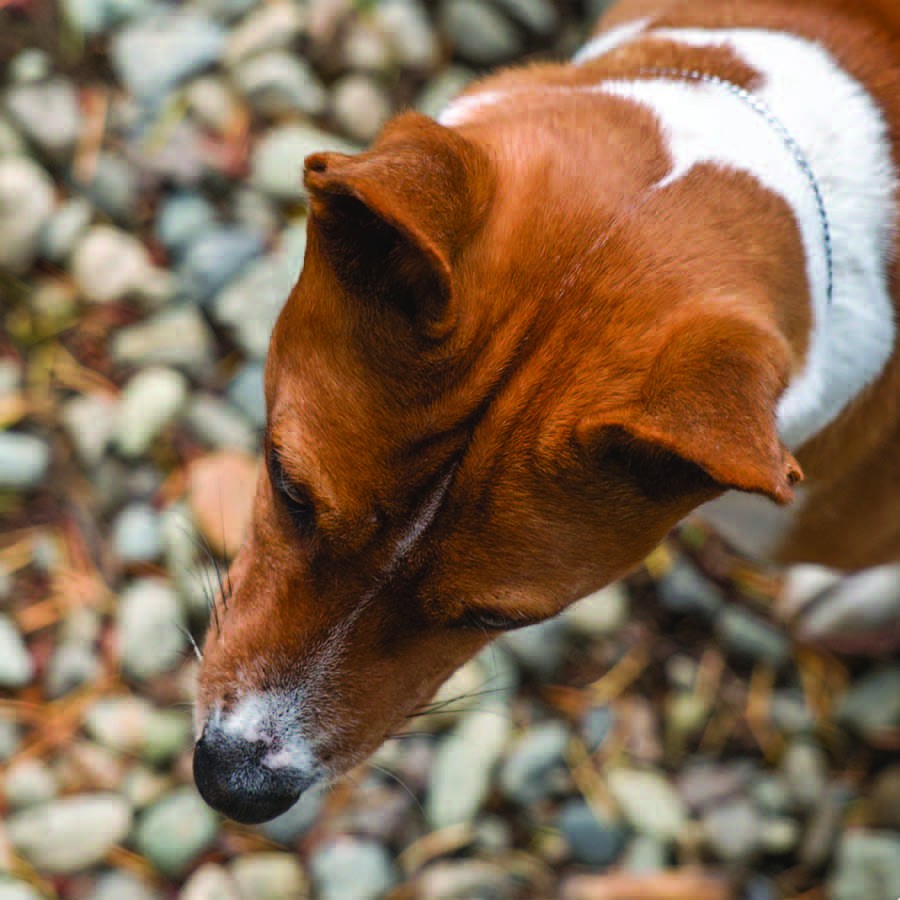
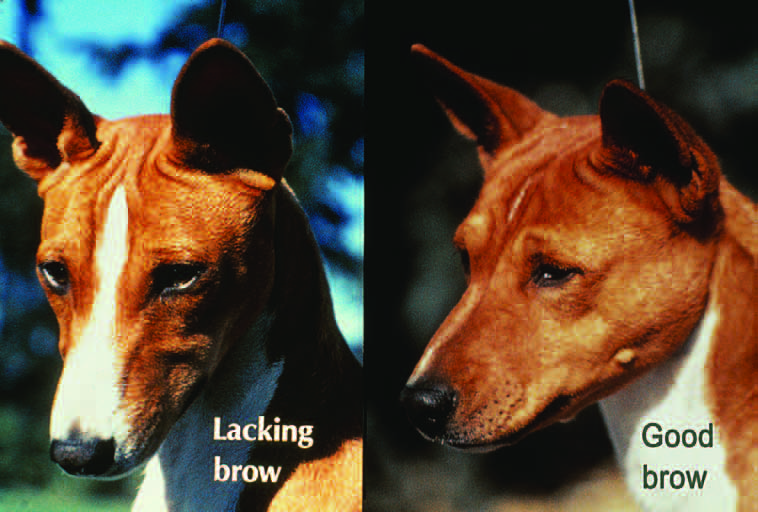
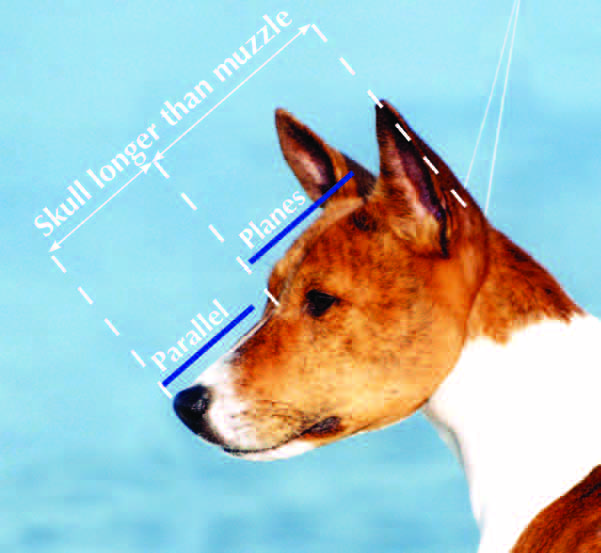
The well-developed arch over the eye gives character to the head. In profile, the muzzle continues in a line parallel to that of the flat skull. A domed or peaked skull or a coarse skull or muzzle are undesirable. The distance from the back of the head to the stop is greater than that from the slight stop to the tip of the nose.
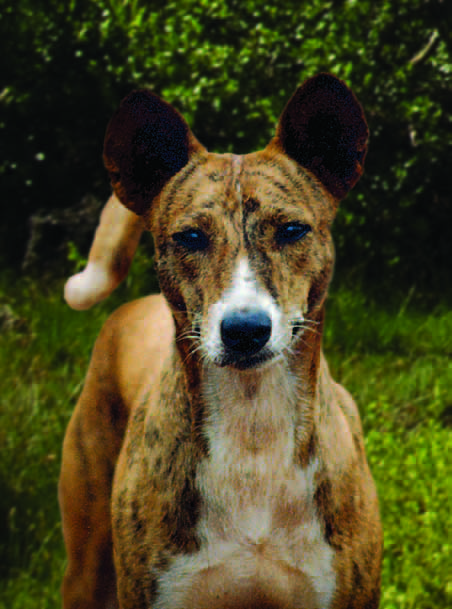
The far-seeing expression of the eye is dependent on position, shape and angle. The color of the iris is dark, and the eyes should be small without being piercing or button-like. Light eyes or round eyes are undesirable.
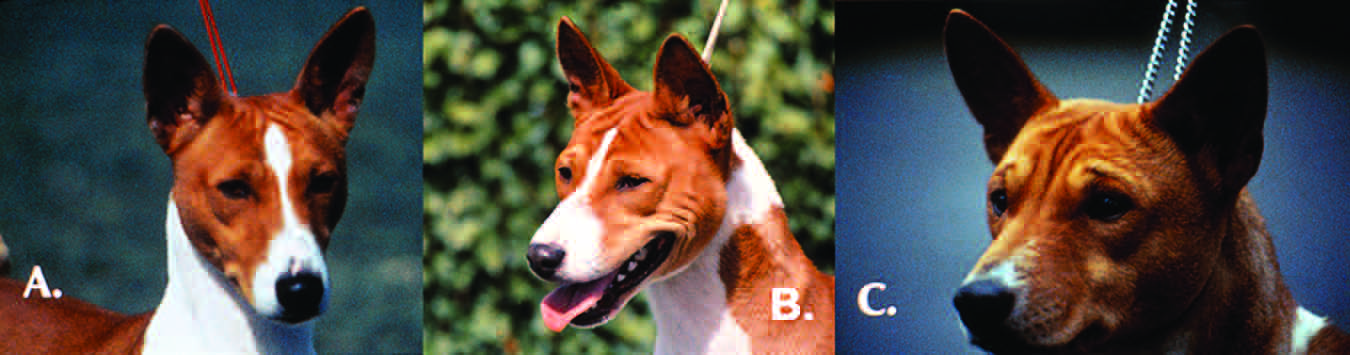
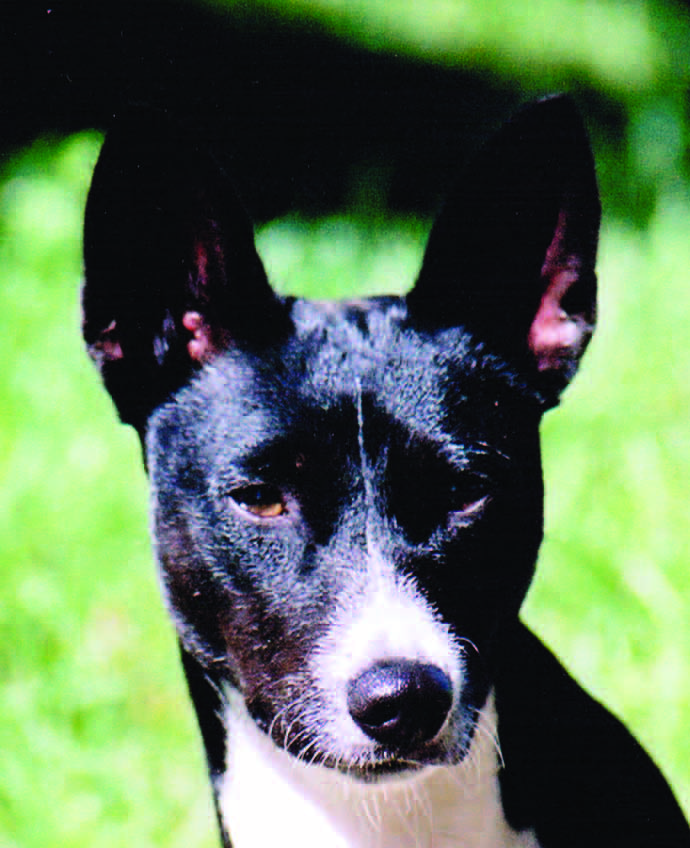
The tip of the ear should be nearer to the center of the skull than to the outside base. The ears are slightly hooded in that the tips are directed more forward than the base. It is the high set of the ears and the pricking forward when alerted that produces the fine wrinkle and quizzical expression so typical of the Basenji. Large and/or low set ears are not desirable.
Neck, Topline, Body
Neck of good length, well crested and slightly full at base of throat. Well set into shoulders. Topline: Back level. Body: Balanced with a short back, short coupled and ending in a definite waist. Ribs moderately sprung, deep to elbows and oval. Slight forechest in front of point of shoulder. Chest of medium width. Tail: Set high on topline, bends acutely forward and lies well curled over to either side.
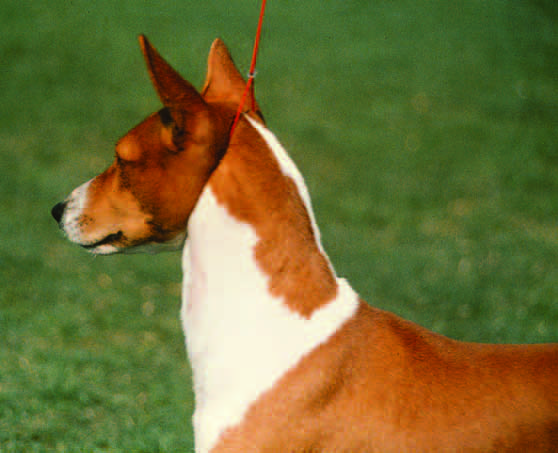
The neck of good length provides length to the muscle that extends from the head to the upper arm. It also ensures maximum range of shoulder blade action and promotes free forward movement of the forelimbs.
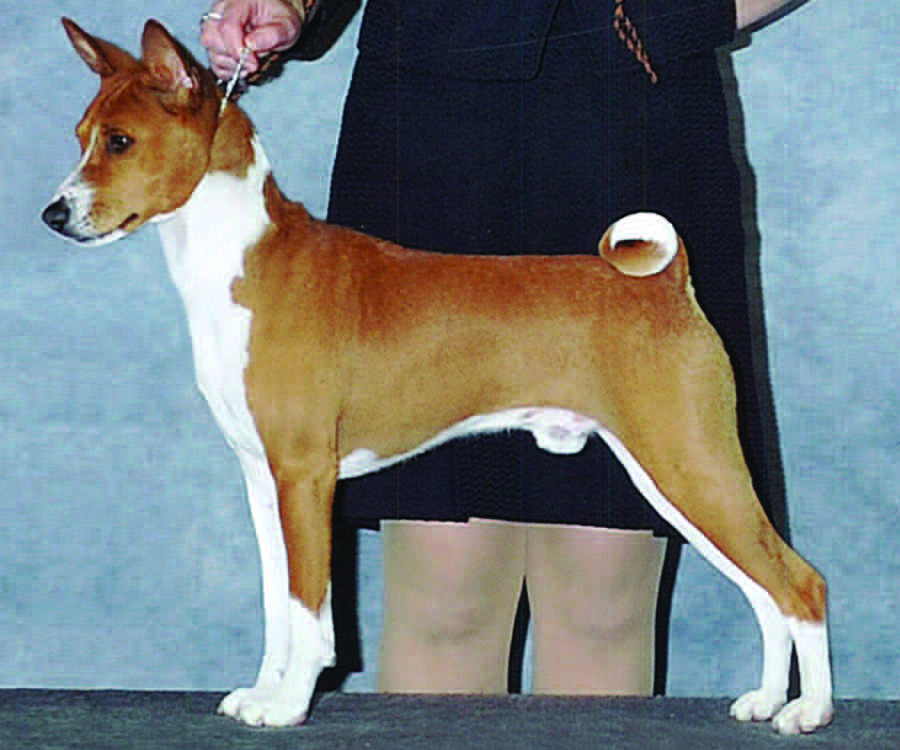
The length of neck is increased by a blending into laid-back shoulders. A good length of neck, well-crested, allows the dog more mobility and balance as well as enhancing the aristocratic appearance. The throat is clean without loose skin. Note that a full white collar can give the impression of a longer neck. Ewe necks and necks that meet the withers abruptly without a smooth transition are undesirable.
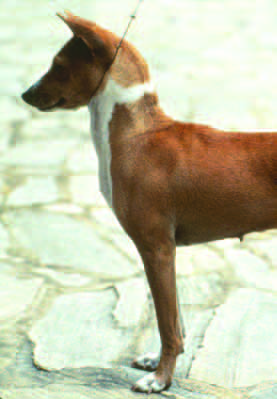
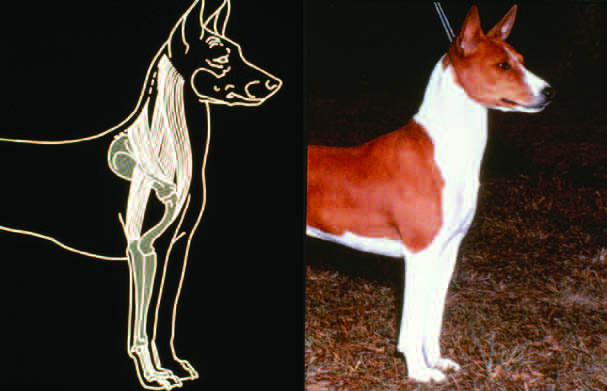
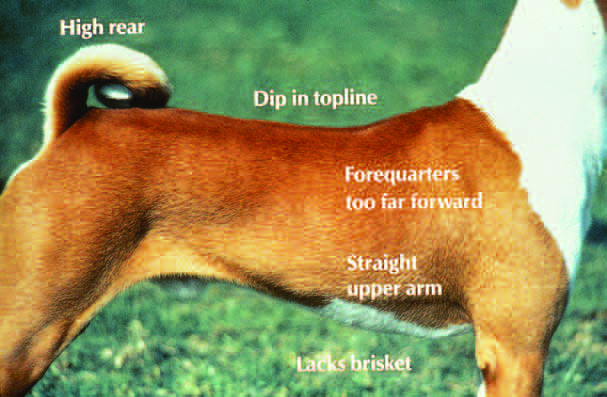
The Basenji should have a level back. Dogs that are naturally high in the rear are often made to appear to have level toplines by stacking the hind legs far out behind or very wide. Toplines should not roach or dip.
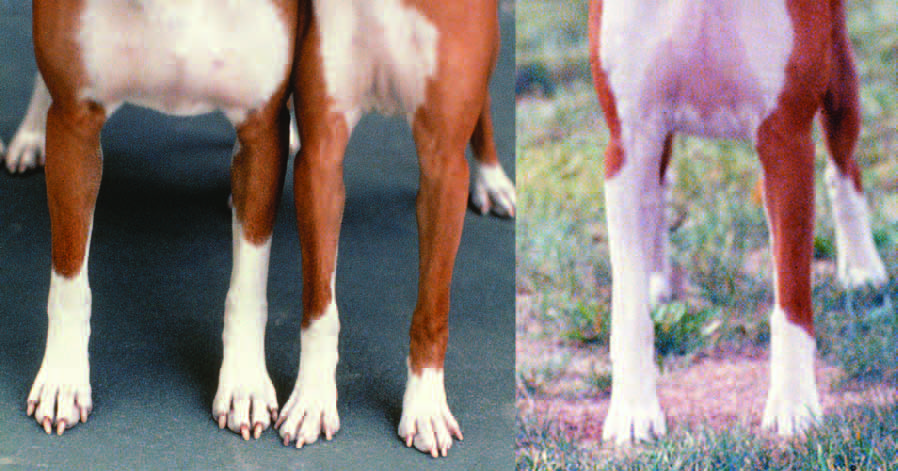
Proper chest development contributes to proper movement. We emphasize that the Basenji should measure square.
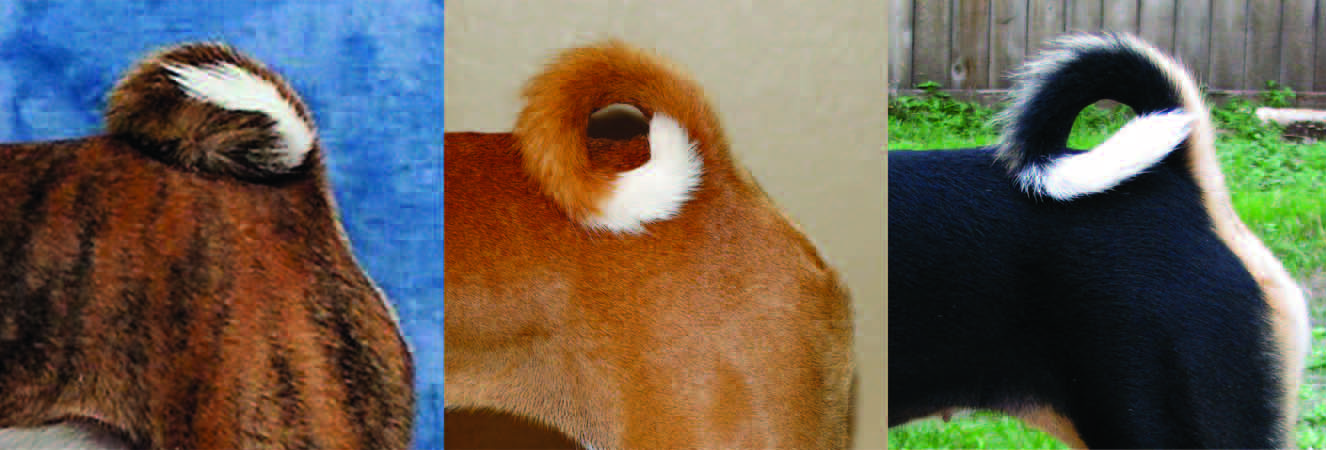
The tail should be set high on the croup, curled to one side or the other. The set is more important than the tightness of curl as the set is essential for correct rear assembly.
Forequarters
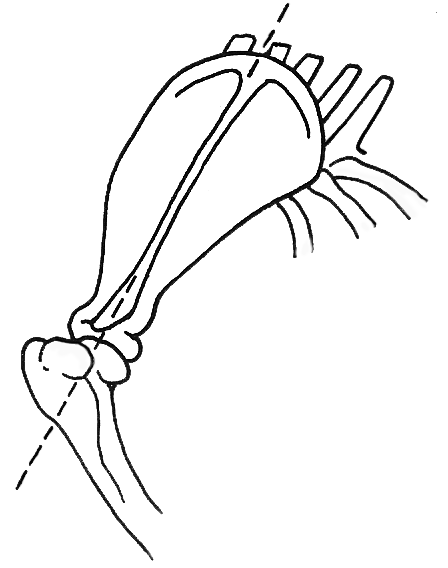
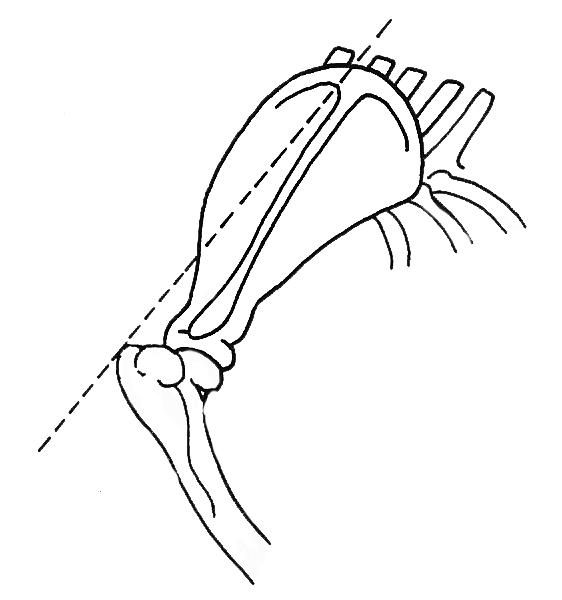
Shoulders moderately laid back. Shoulder blade and upper arm of approximately equal length. Elbows tucked firmly against brisket. Legs straight with clean fine bone, long forearm and well defined sinews. Pasterns of good length, strong and flexible. Feet: Small, oval and compact with thick pads and well arched toes. Dewclaws are usually removed.
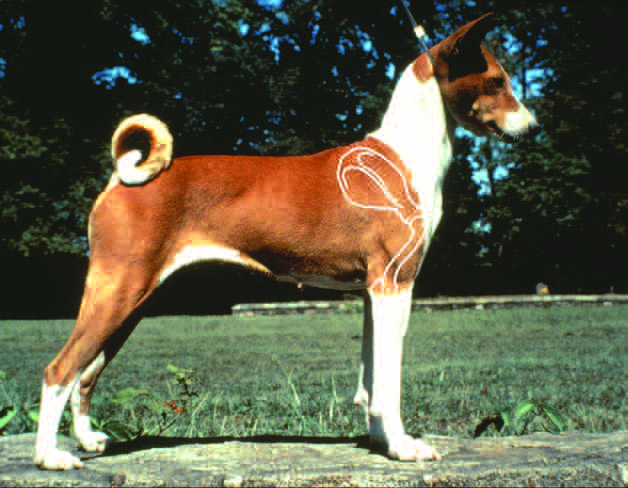
A shoulder angle of about 30 degrees from the vertical can be considered moderately laid back. The upper arm should be long and about the same length as the shoulder blade, and the elbow should be set approximately under the tip of the shoulder blade.
Pasterns should not be weak and sloping, nor rigidly upright nor knuckled over.
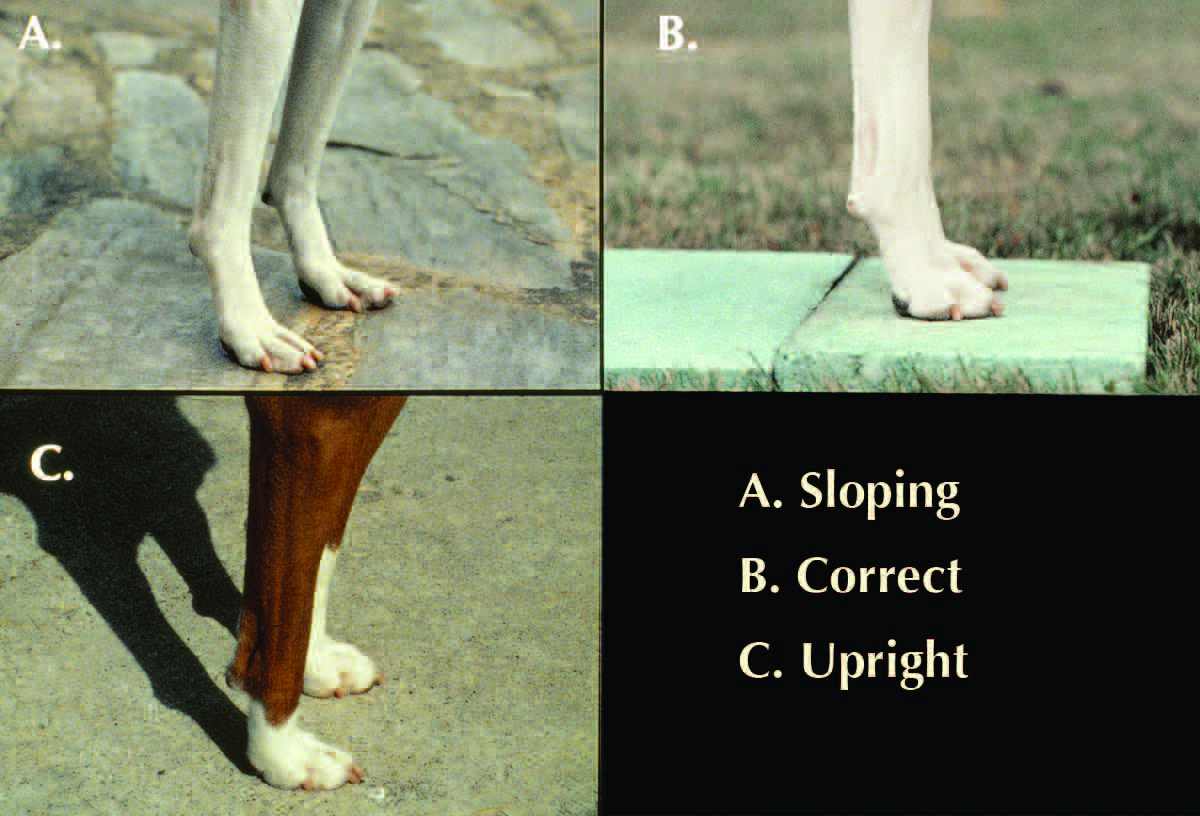
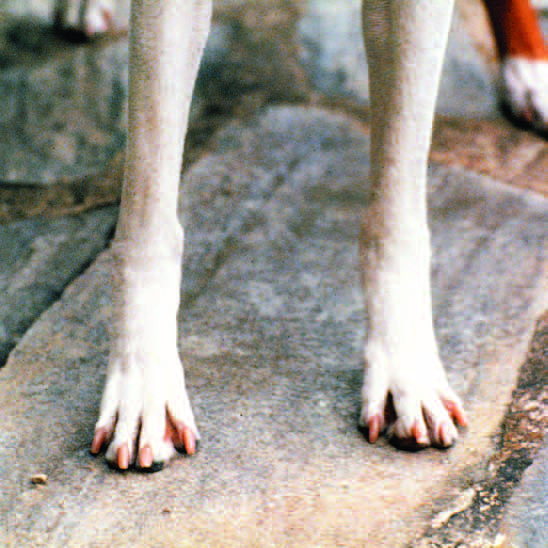
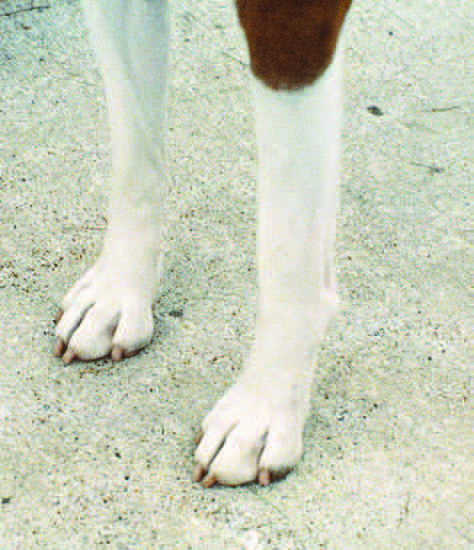
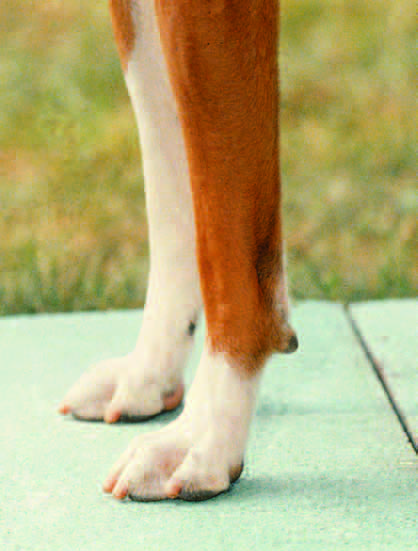
In these photos of good feet, note how thick the pads are. An oval, rather than a cat foot, is required. Flat or splayed feet should be heavily penalized. The Basenji is a hound and thin, open feet are subject to recurrent lameness.
Hindquarters
Medium width, strong and muscular, hocks well let down and turned neither in nor out, with long second thighs and moderately bent stifles. Feet: Same as in Forequarters.
The key to the appreciation of correct Basenji hindquarters is the requirement for moderate angulation.
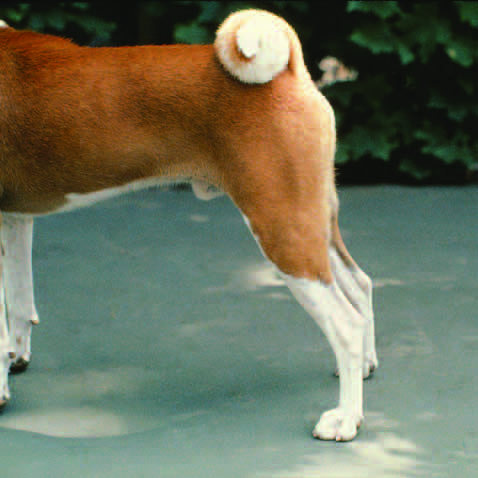
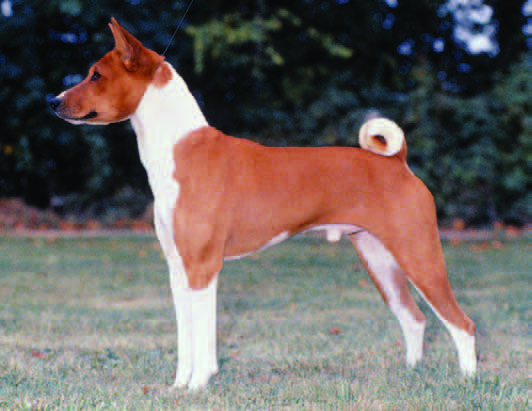
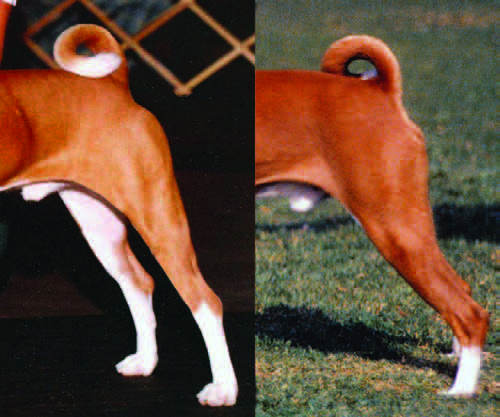
A straight rear with high hocks will generally have restricted rear motion. Over-angulated hindquarters overpower the front, resulting in crabbing, pounding or other examples of movement imbalance.
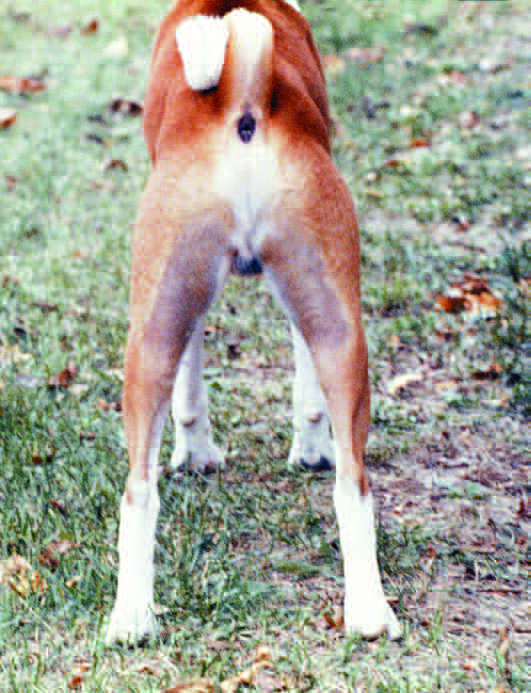
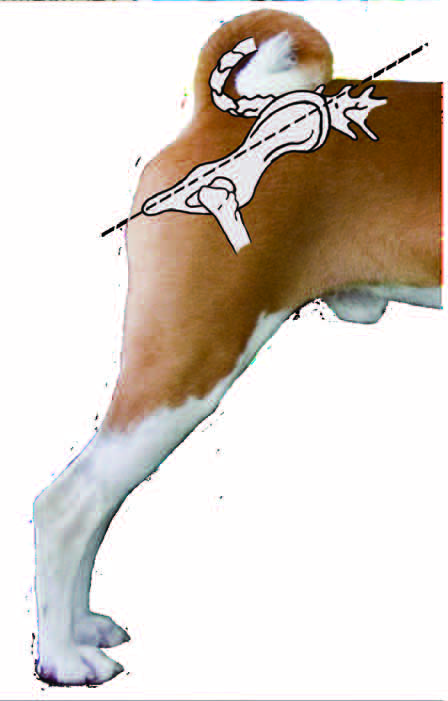
Maximum propulsion without increasing angulation is achieved by ensuring that the rear portion of the pelvis is long. This length creates the appearance of a shelf behind the high-set tail. The hocks should be well let down for endurance. Viewed from behind, the column of bones from hip to pad should be straight, converging toward the center of gravity as speed increases.
Coat and Color
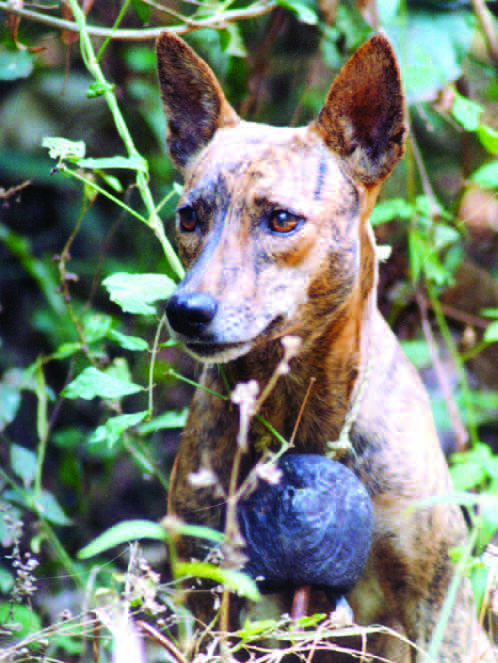
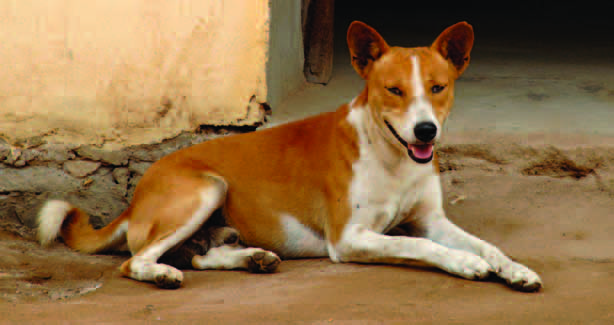
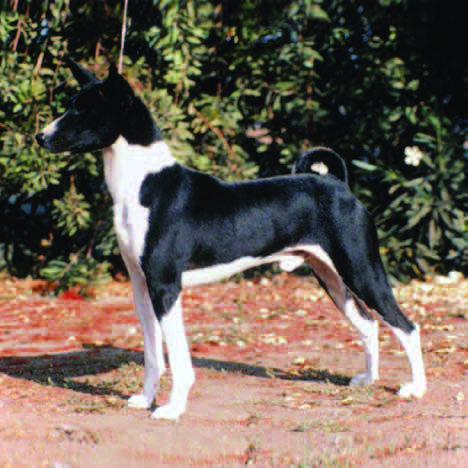
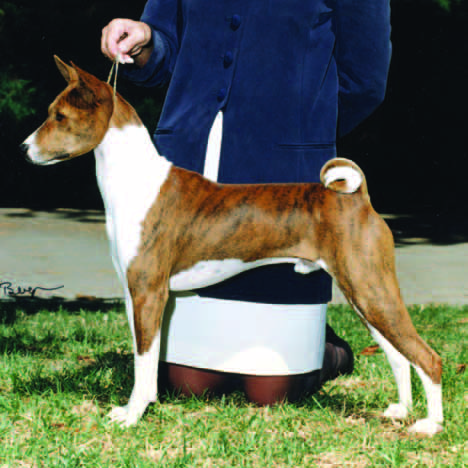
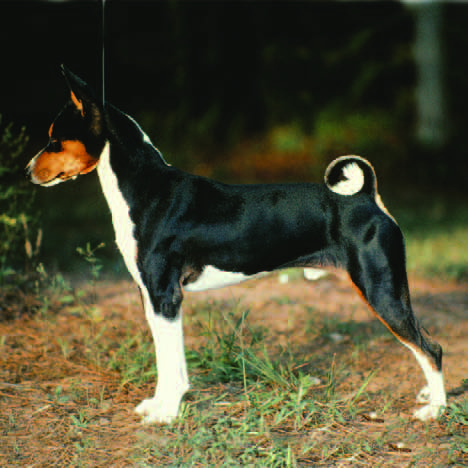
Coat short and fine. Skin very pliant. Colors: Chestnut red; pure black; tricolor (pure black and chestnut red); or brindle (black stripes on a background of chestnut red); all with white feet, chest and tail tip. White legs, blaze and collar optional. The amount of white should never predominate over primary color. Color and markings should be rich, clear and well-defined, with a distinct line of demarcation between the black and red of tricolors and the stripes of brindles.
The skin texture is very important. It should be thin and elastic, yet strong. Coarse skin cannot produce the fine profuse wrinkles characteristic of the breed. The hair itself is silky but often somewhat stiff. This hard surface collects little dirt.
Red/White. The red color should be bright and rich, sometimes with an orange cast, sometimes ranging more toward chestnut. Areas of clear white or clear color are greatly desired. A few black hairs on the back side of the ears or the inside of the curl of the tail indicates the dog probably carries the genetic factor to produce tri-color offspring and such markings should not be penalized.
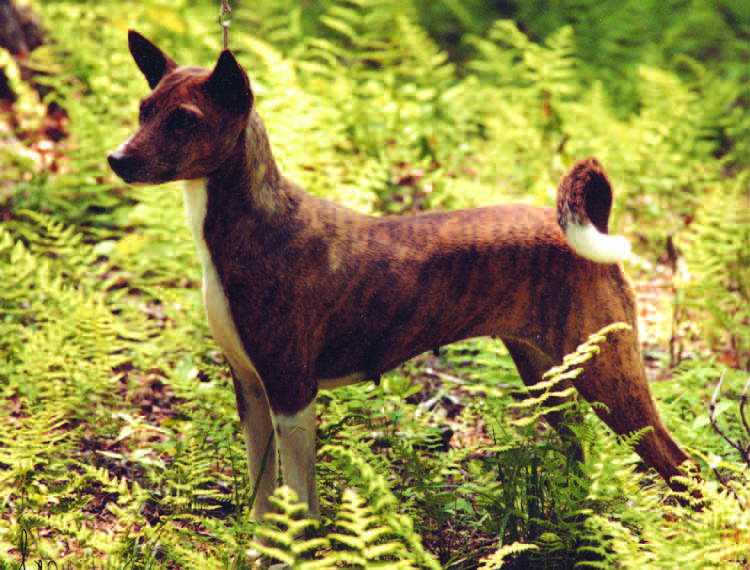
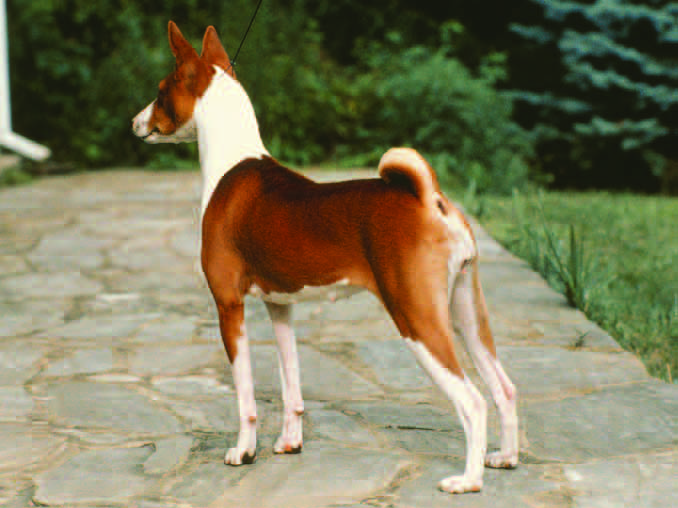
Black hair developing a mask on the faces of the reds or tris is not desirable.
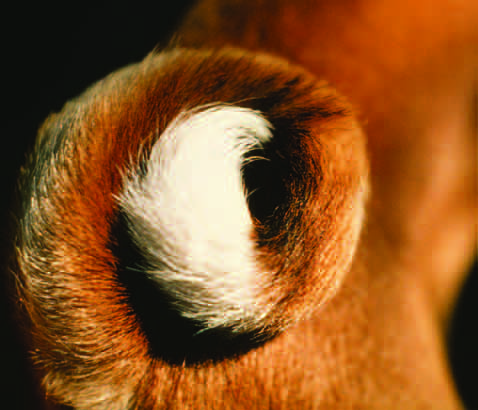
Black/White. On the blacks the color is a pure, glossy, jet black with distinct demarcation between the black and the white. White or red hairs interspersed with the black creating a grizzled effect is not pleasing.
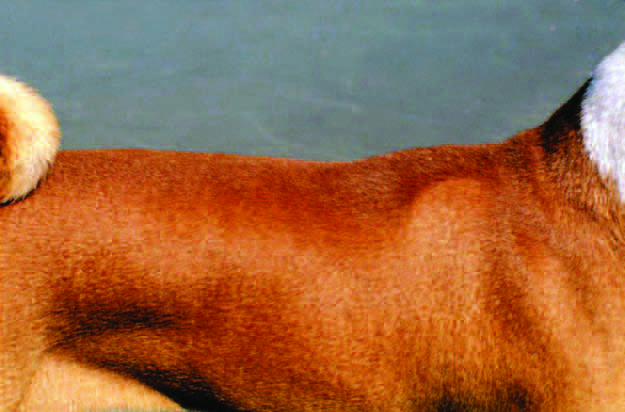
Black/Tan/White. The coat of the tri-color is as glossy and dark as the black and white, with the addition of tan. Tan markings are desired above the eyes (pips), on the muzzle, cheeks, inside the ears, legs, back of thighs, breeching, vent, underside of the tail, and the lower outside portion of the legs between the white and black. The brindle-pointed tri-colored basenji may have black stripes in the areas of red and should not be penalized.
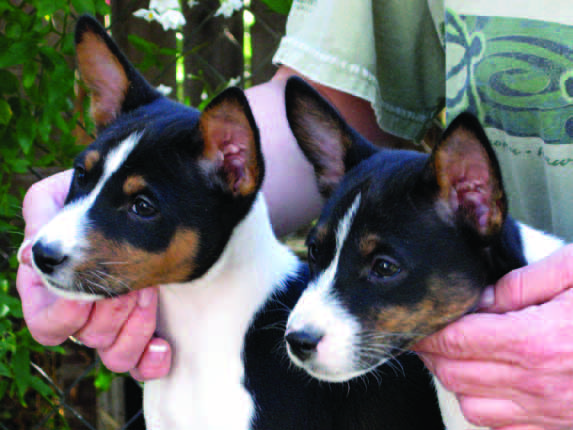
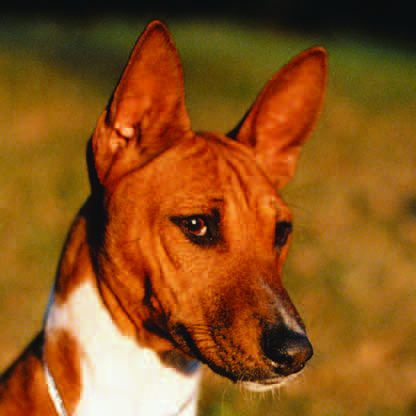
Brindle/White. The brindle should have a good rich chestnut base color with strong black stripes over it. The colors should remain fairly distinct to avoid a muddy, grizzled or sable effect. Such effects are incorrect on any of the allowed colors.
Gait
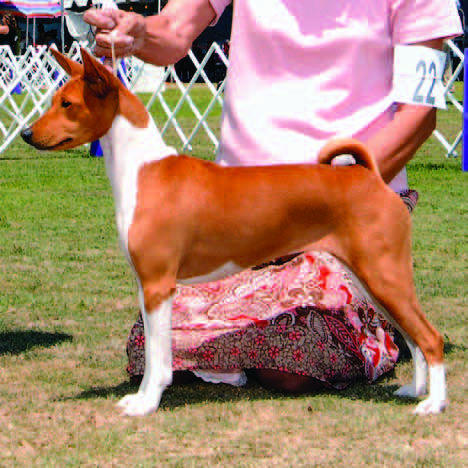
Swift, tireless trot. Stride is long, smooth, effortless and the topline remains level. Coming and going, the straight column of bones from shoulder joint to foot and from hip joint to pad remains unbroken, converging toward the centerline under the body. The faster the trot, the greater the convergence.
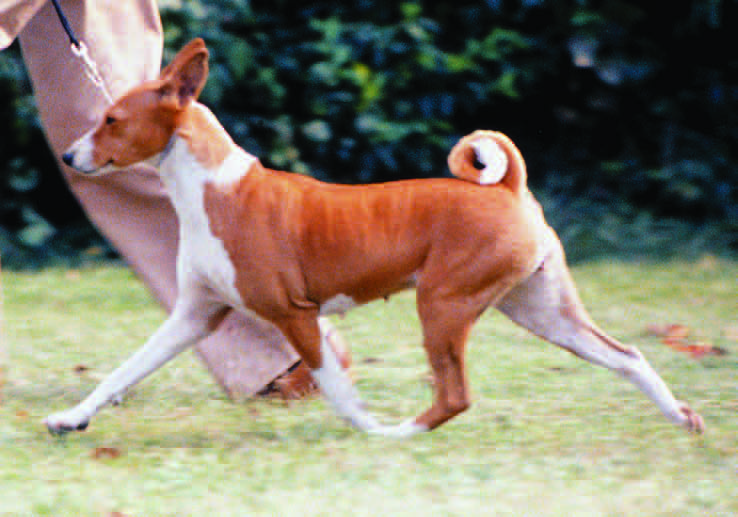
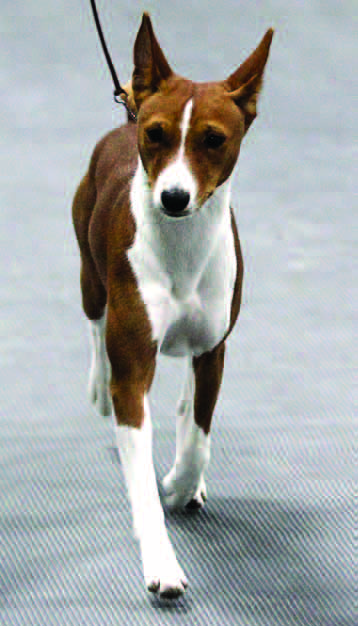
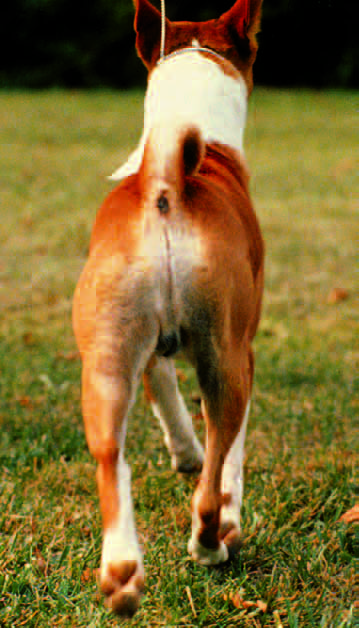
There should be no bounce to the shoulders, and the topline should remain level. The reach should be efficient with good shoulder rotation and elbow extension. The rear leg should reach well under the body while the follow-through should extend an equal distance behind.
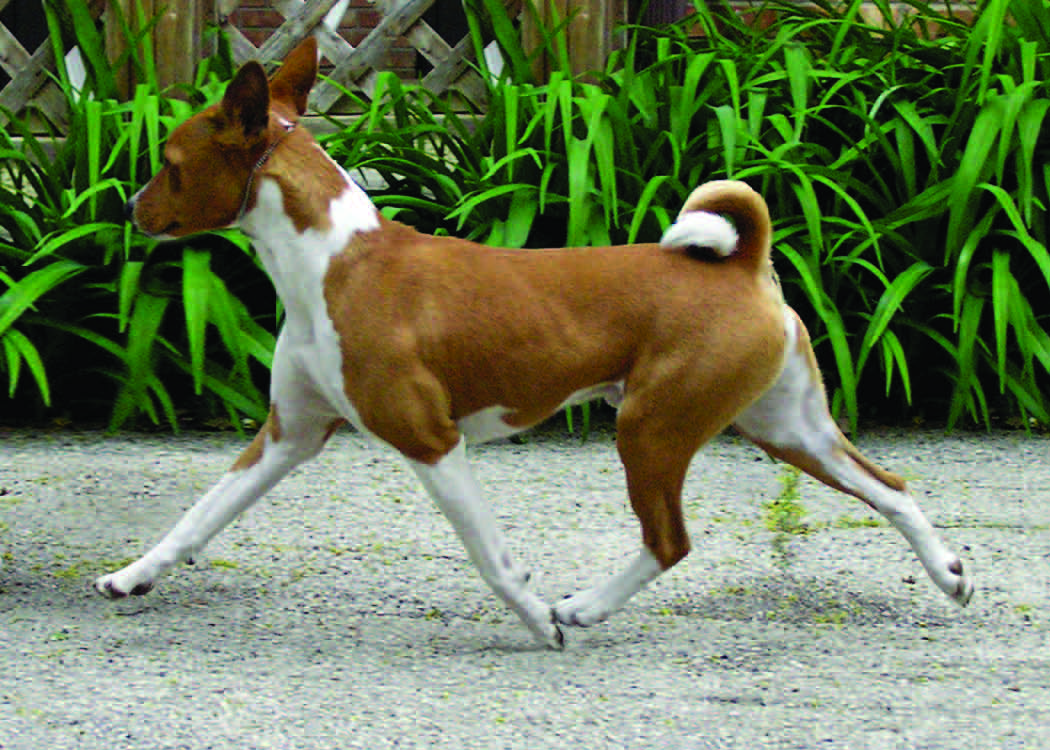
Excessive action, or high, or hackney action is inefficient and fatiguing. Exaggerated kick, which offers no additional propulsion, should be avoided. In Basenji gait, overall balance and timing are of primary importance.
Temperament
An intelligent, independent, but affectionate and alert breed. Can be aloof with strangers.
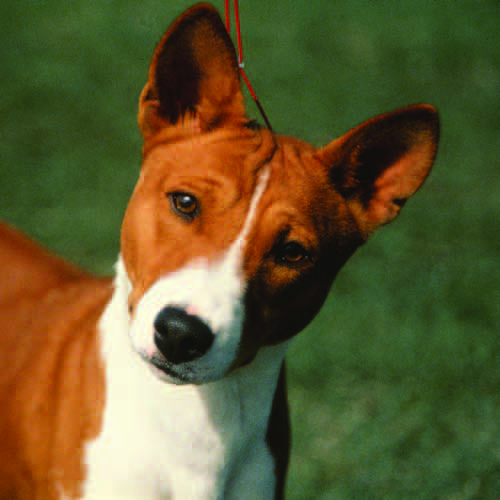
For uncounted thousands of years the Basenji survived as a hunting dog. Great importance must have been given to intelligence and adaptability for the dog often worked out of sight of the hunters. At times the Basenji can still be quite independent and aloof. It is alert and careful with strangers, open and calm with friends, loving and solicitous with children.
When meeting strangers, Basenjis prefer to make the first overtures and should not be approached from behind. Although not high strung, the Basenji is an alert, active, curious dog. Judges should not expect it to stand motionless for long periods of time.
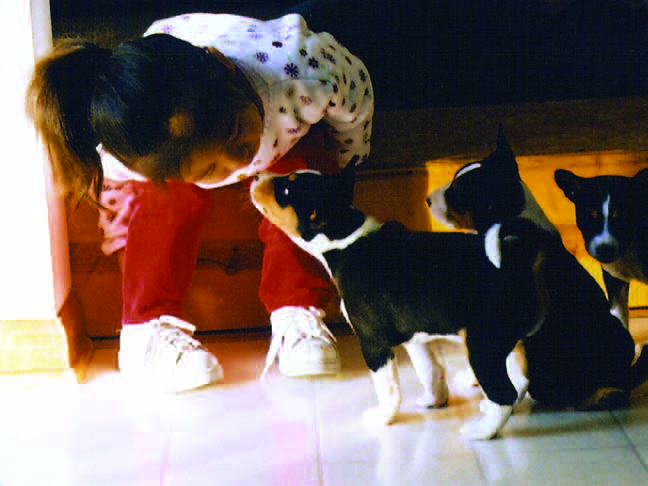
Summation
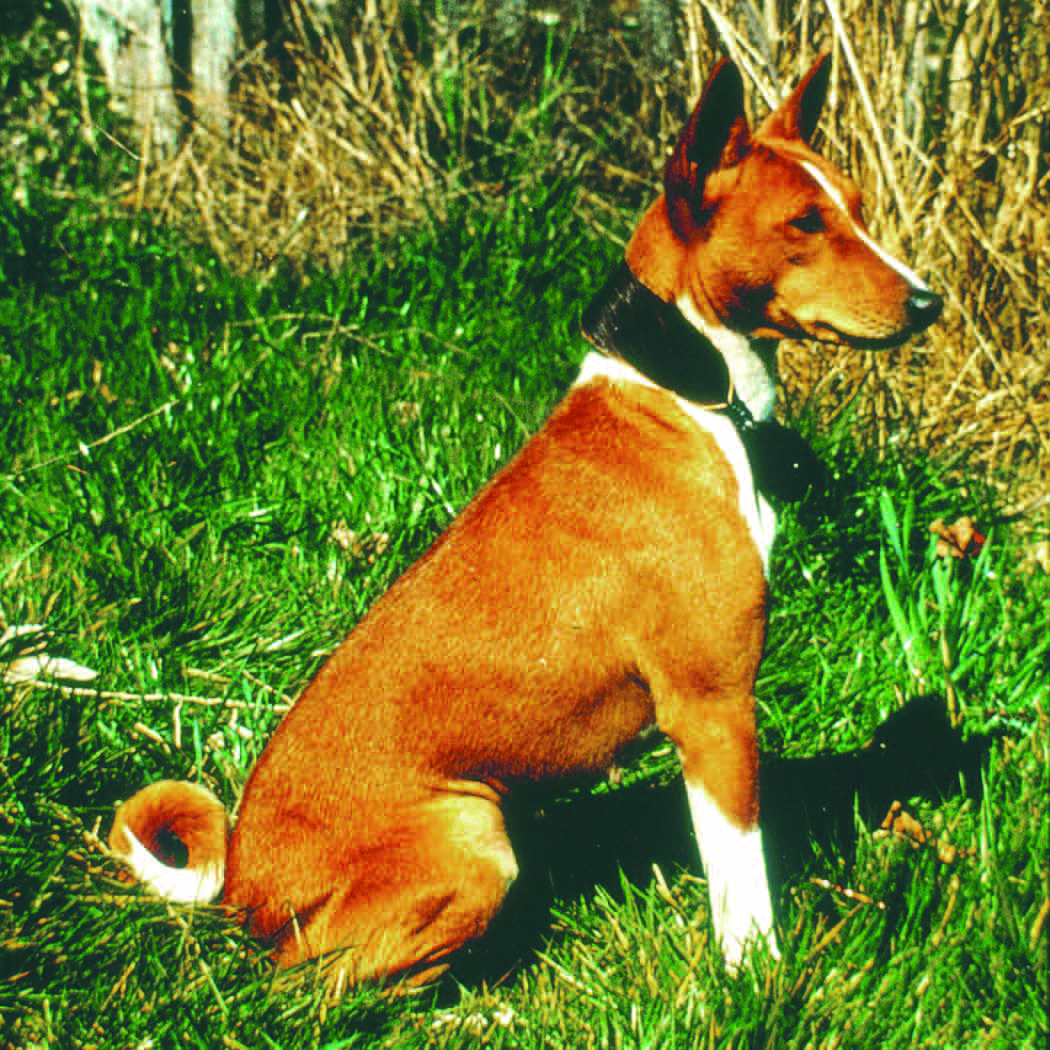
The Basenji is a multi-purpose dog which has survived thousands of years of intense natural selection because of its intelligence and adaptability. It is balanced and light footed, yet strong and enduring. It is elegant yet substantial. Ever proud and alert, it is a dog that can look its master in the eye, a dog that can bring pride to breeder, owner and judge alike. Older than a museum relic, the Basenji is the personification of natural beauty.
Approved May 8, 1990. Effective June 28, 1990.
Addendum: Native Basenjis
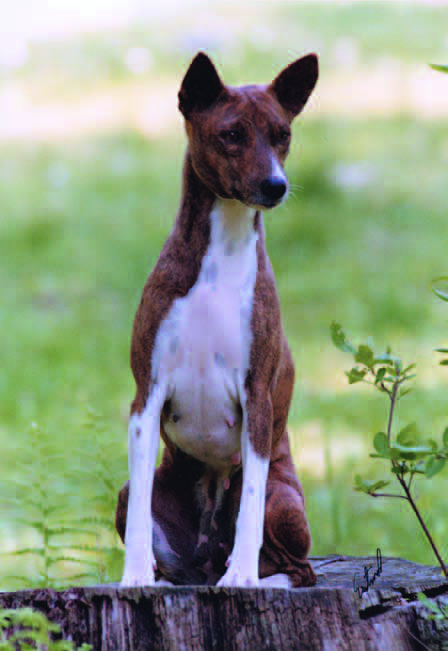
The Basenji Club of America, Inc. is fortunate to be able to incorporate native Basenji stock into its gene pool.
In the late 1980s Basenjis were imported from Africa, and in 1990 the Club requested the American Kennel Club open the Studbook to accept these dogs. Again, in 2008, BCOA received permission to re-open the AKC Studbook to allow the BCOA to continue adding carefully selected African imports throughout the next several years for breeding programs. These dogs live in much harsher conditions than their domestic counterparts. Diet and environment may hamper their development to some degree. A looser tail curl or a longer loin is more likely seen in the native dogs. Basenjis in Africa are not the product of careful selection as is the case in this country. They survive the elements of their surroundings because they are the strongest and hardiest.
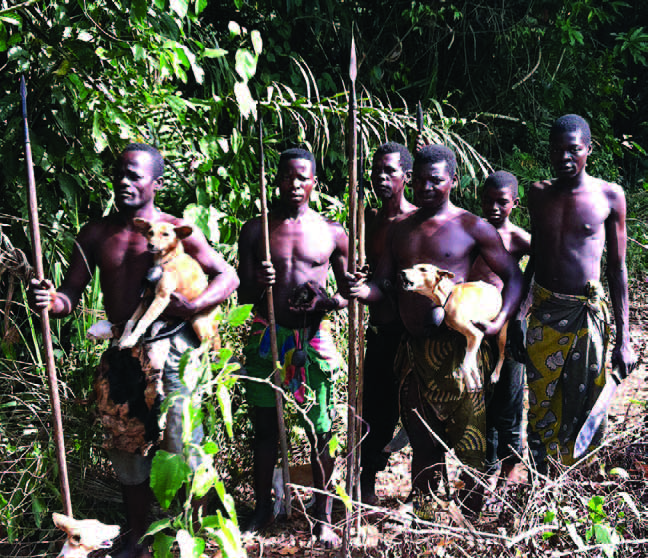
Importers have visited several areas in the Congo Basin to search for Basenjis. Since the late 1980s, more than thirty native Basenjis have been approved and registered as AKC Foundation Stock, with additional applications under review. Details of each dog's application are available on the Native Stock Project page.