
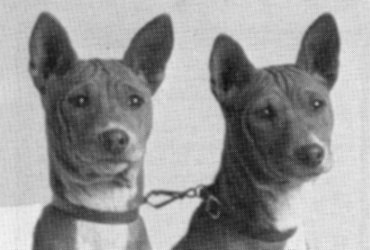
I receive a lot of letters from the States, nearly always extremely kind and often far too complimentary. Even so, they make me very happy.
I had been going through some old letters, as I have to clear them out periodically, when I found the following letter, and this extract is perfect for what I want to say. It was written by a very famous breeder just after I last judged in the States (1975). He wrote "It was my great pleasure to have met and talked with you, I agreed with all you said and hopefully we will meet again. Veronica, your evaluation of Basenjis in America is a true and honest one, and we are all guilty of not holding to the standard. But please believe me when I say that some of us are trying."
You must remember that I have not done any breeding for a number of years, so I have no axe to grind, and never have I hope. I have always tried to stick to the standard so carefully taught to me by the famous pioneers of the breed: Mrs. Burn, the late Lady Helen Nutting, Lady Kitty Ritson, Captain Richards and Mr. K. B. Smith, all of whom knew Basenjis in the Congo and South Sudan. Once you have seen a number of the right type anything else is displeasing to the eye.
What worried me when I judged in America were so many long muzzles and quite a lot of round light eyes. Many of the muzzles were as long as the skull with some even longer. The original description was that the muzzle should be approximately one third the length of the skull. The skull is measured from stop to the highest point on top of the head.
I have even heard it said that some in America want "balanced" heads. It was explained to me that a balanced head is when the skull is equal in length to the muzzle. My description of this would be an "unbalanced" head. It is totally wrong and completely spoils the unique Basenji expression. A good test of this change in the Basenji head is to take the "blue Basenji book" which I wrote in 1954 (with a number of later reprints) and note that practically every dog illustrated has a short muzzle and typically correct Basenji expression. Then compare those heads with various editions of THE BASENJI. I think you will find a big change in heads and expressions, and they are certainly not for the better: with muzzles too long, some with a fill-up like a bull-terrier, eyes round and light (even in black and white photos you can judge a light eye by its being pale, with a black pupil showing up distinctly), other eyes are set too high, or too close together giving a mean appearance. Some of the heads would do justice to Collies.
This warning doesn't just apply to the States. We are getting some bull-terrier type heads in Britain; Australia is getting light eyes and a few long muzzles. We are all losing wrinkle. Perhaps this well meant warning will make people take a long clear look at their dogs and see faults in them which they had not noticed. These faults can be bred out.
Untypical Heads
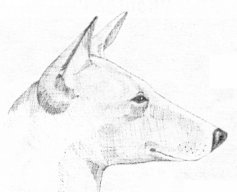
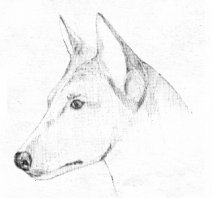
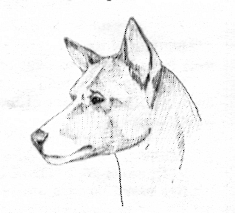
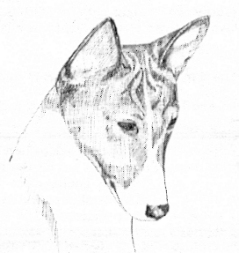
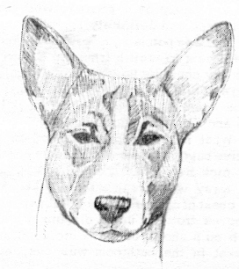
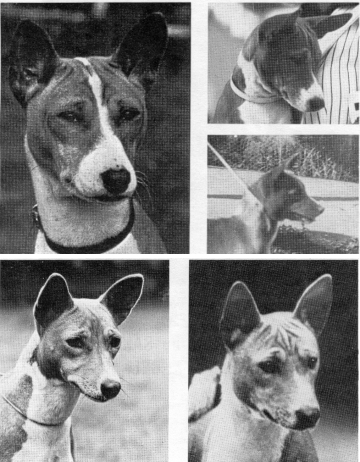
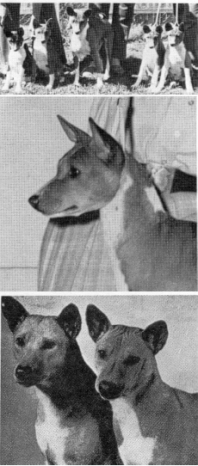
These photographs represent a sampling of typey Basenji heads including some of the original stock imported from Africa, some dogs from years gone by and some current dogs in several countries. Note overall shape of the head, relationships of planes, length of muzzle, and shape, color and location of the eyes.
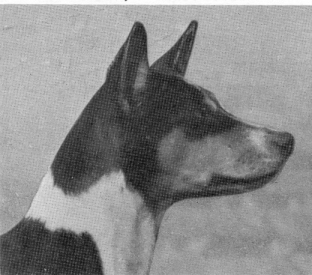
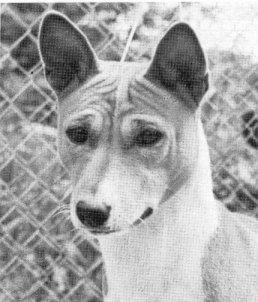
by Veronica Tudor-Williams, with suggestions from various breeders and illustrations by Susan Coe.
Reprinted from The Basenji, Volume XVIII, Number 4, April 1981, pp. 8 and 9. Copyright © 1981 The Basenji. All rights reserved. Used with permission.