
Esenjo
“Esenjo”
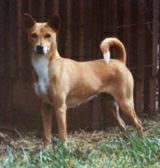
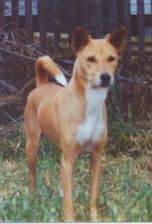
Mr. Luis Clark worked for the Morrison-Knudsen International company in Zaire which was building the Inga-Shaba electrical line. The line started at the Inga hydro station near the mouth of the Congo river and ended in Shaba (now Katanga) province at Kolwezi. Mr. Clark traveled along the route of the transmission line several times while in Zaire. The company had headquarters at Lubumbashi just east of Kolwezi and it is here where Mr. Clark met the local pygmies recruited to work on the line. The pygmies would not sell a Basenji but Esenjo, meaning happiness, was a present to Mr. Clark in appreciation of a gift of two water buffalo when food was scarce. Esenjo had a scissors bite, oblique eyes, fine wrinkle and hooded ears. She had true, strong movement. She stood four square with strong musculature. She had low tailset and loose, single-curl tail. She was highly intelligent and had excellent temperament.
Litters produced
August 6, 1983 - 1 red and white male and 5 red and white females - Breeders: Margaret Sommer and Cathy Clark
-
Sire: Rameses Tut-Ankhamen (R/W)
-
Am. Ch. Pero's Krugerrand
- Am. Can. Ch. Enzi Kidogo of SunDiata
- Am. Ch. Pero Precious Charm
-
Shetari's Peppermint Patty
- Eng. Can. Am. Ch. Fulafriend of the Congo
- Am. Ch. Fula Nefertiti of the Congo, CD
-
Am. Ch. Pero's Krugerrand
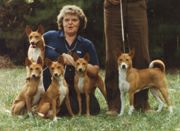
Offspring. Esenjo and Ramess Tut-Ankhamen's eyes were tested as clear of PPM and coloboma and they were free of HA. The three from the litter who were bred from were the male Ebo of Esenjo and the females Efe' of Esenjo and Endo of Esenjo and litter sisters Ebebba of Esenjo, Edea of Esenjo and Ebibiyin of Esenjo were not bred from. The litter sired by Ebo and out of Efe' was whelped October 29, 1987 and produced 2 red males and 3 red females. The litter by Ebo and out of Endo was whelped January 3, 1995, and had one red male and one red female. All eyes were PPM and coloboma tested clear. Comments are on all Esenjo descendents including parent generation through the fourth generation: All litters were inbred to maintain the 50-50 genetic ratio of the parent generation. There were seven brother and sister matings and one mother and son mating. There are also three outcross litters extant not included in this data. 9 litters produced 15 males and 15 females - all red and white. All males had two testicles All had good bites Eyes: 50% have tested clear of PPM and coloboma and 50% are yet to be tested. All had excellent temperaments All are typical of the breed and had sound movement Colors: 29 clean red and whites (1 had too much white) and 1 red and white had black sabling on the back 1 pup had a small umbilical hernia and 1 pup had external intestines. Top: Ebo and Bottom: Edea, Endo, Ebibiyin and Efe'